
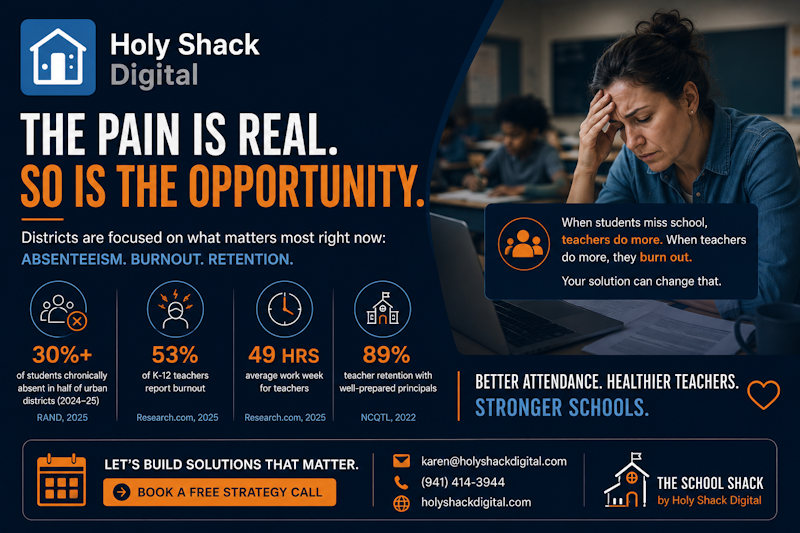
Ask most EdTech marketing teams what their buyer cares about, and you'll hear "student outcomes" or "engagement." Ask an actual superintendent, and you'll hear two words a lot more often right now: absenteeism and burnout.
If your positioning doesn't speak to at least one of these, you're solving a problem your buyer isn't currently losing sleep over.
Chronic Absenteeism Hasn't Gone Away — It's Plateaued at a Crisis Level
Chronic absenteeism — generally defined as missing 10% or more of the school year — climbed from about 13% of students in 2017 to 29% in 2022, and it's barely moved since. RAND's spring 2025 survey of the American School District Panel found that in roughly half of urban school districts, more than 30% of students were chronically absent during the 2024–2025 school year. In California, one of the few states with detailed recent tracking, the chronic absence rate improved only about one percentage point in 2024-25 after several years of steadier declines — landing at 19% of students statewide.
This isn't a niche issue. It's arguably the single biggest drag on academic recovery. A comprehensive study covering more than 8,700 districts found that districts with high post-pandemic absenteeism recovered more slowly academically, and that socioeconomic achievement gaps have widened by roughly 11% since the pandemic began — driven in part by uneven absenteeism trends between affluent and low-income districts.
Why this matters for your pitch: A growing number of district leaders now describe absenteeism as an engagement problem, not a compliance problem. One veteran superintendent put it bluntly in recent commentary: decades of tightened attendance policies and monitoring tools haven't solved it, because the root issue is a breakdown in student engagement, not a lack of enforcement. If your product frames itself purely as an attendance-tracking or compliance tool, you're pitching the old solution to a problem districts have already concluded needs a different answer.
Teacher Burnout Is Now a Retention Crisis, Not Just a Morale Issue
Recent data puts teacher burnout at 53% of K-12 teachers, working an average of 49 hours a week — about 10 hours beyond their contracted time. That's not a soft statistic; it's a direct predictor of attrition, and attrition is expensive and disruptive for every district it hits.
There's also a connection between these two pain points that most vendors miss entirely: absenteeism drives burnout. When students miss school, teachers don't just teach to a smaller room — they take on the added burden of reteaching, differentiating, and catching kids up, on top of their existing workload. One survey found that over 40% of educators cite insufficient staff time for intervention execution as their primary challenge in addressing absenteeism. Separately, teacher absenteeism itself rose from 24% to 32% between the 2018-19 and 2022-23 school years, meaning the staffing strain compounds in both directions.
Why this matters for your pitch: A tool that reduces teacher workload isn't just a "nice to have" efficiency feature anymore — it's a retention strategy. Positioning your product as something that gives teachers time back, rather than one more system to learn, speaks directly to the crisis administrators are actually trying to solve.
Leadership Quality Is the Multiplier Districts Are Starting to Invest In
One data point worth building into any pitch aimed at a superintendent or HR director: schools led by well-prepared principals retain teachers at an 89% annual rate, compared to 78% in schools with less-prepared leadership. In high-need schools specifically, strong principal leadership has been shown to erase much of the retention gap between disadvantaged and affluent campuses. Positive school climate — something principals shape directly — is also one of the strongest predictors of whether students show up consistently.
Why this matters for your pitch: If your product supports school leaders directly (not just teachers or students), you're touching the lever research increasingly points to as the highest-impact investment a district can make.
Building Messaging Around What's Actually True
The through-line across all of this data: districts aren't looking for "innovative" tools anymore. They're looking for tools that measurably reduce the two things draining their system — kids not showing up, and teachers leaving because the job has become unsustainable. Frame your product around one of those two problems specifically, with real numbers, and you'll out-message almost every competitor still pitching generic engagement language.
How Holy Shack Digital Can Help
Pain-point messaging only lands if it's backed by real proof and reaches the right decision-maker. Through The School Shack, Holy Shack Digital builds:
LinkedIn and Meta content campaigns built around specific district pain points — absenteeism, burnout, retention — rather than generic feature lists, so your ads speak the same language superintendents are already using in board meetings.
A website built to convert on outcomes messaging, with lead tracking that shows you exactly which pain-point angle is resonating with which type of buyer.
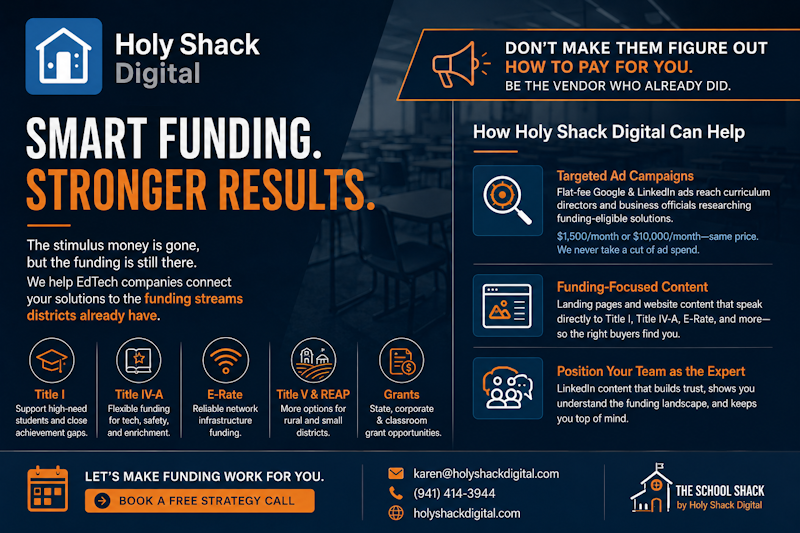
Flat-fee ad management across Google, Meta, and LinkedIn, so testing multiple messaging angles doesn't cost you more as your reach grows.
📅 Book a free strategy call 📧 karen@holyshackdigital.com | (941) 414-3944 | holyshackdigital.com
Sources
District Administration: One Investment Solves Teacher Shortages, Absenteeism and Learning Loss
EdSource: Chronic Absences in Early Grades Linked to Higher Risk of District Transfers
eSchool News: The Unseen Connection Between Student Absenteeism and Teacher Burnout
eSchool News: Engagement, Not Enforcement, Is the Answer to Absenteeism
National Council on Teacher Quality: Addressing the Rise in Teacher Absenteeism

Ready to Fill Your Calendar?
Book a free strategy call — we'll show you exactly how we'd run your ads and grow your business.