In December 2024, a hacker used a compromised support-portal credential to walk out with personal data on roughly 62 million students and 9.5 million educators — records from a company serving 75% of the K-12 student information system market, across more than 18,000 districts in over 90 countries. The attacker, a 19-year-old college student, was sentenced in October 2025 to four years in federal prison and ordered to pay $14.1 million in restitution. The vendor itself paid a $2.85 million ransom, and extortion attempts against individual districts continued for months afterward.
If you sell technology to K-12 districts, that breach didn't just make headlines. It rewired how every IT director now evaluates a new vendor.
What Changed in the Procurement Process
Privacy commissioners in Ontario and Alberta released formal findings in late 2025 concluding that school boards themselves shared blame for the breach, due to inadequate vendor oversight — not enforcing multi-factor authentication, not conducting regular security audits. That finding landed hard. District IT leaders read it as a direct instruction: vendor vetting is now the district's problem too, not just the vendor's.
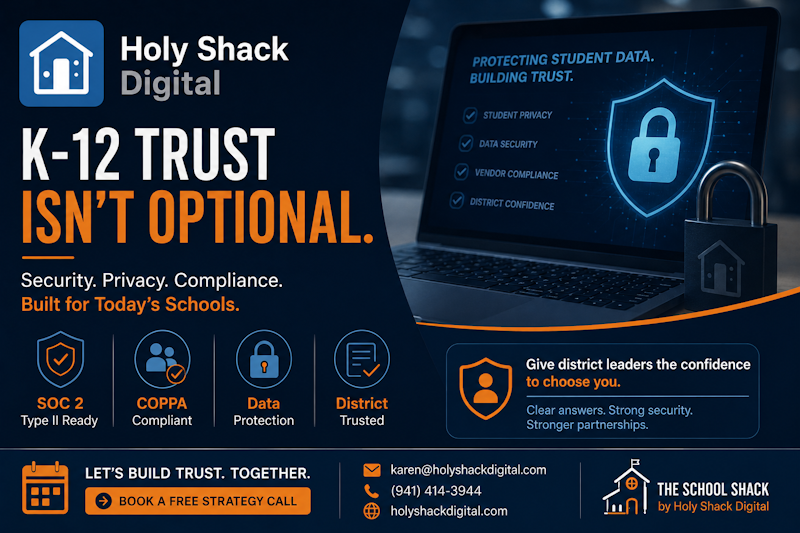
The practical result, according to reporting on the fallout: districts are now demanding proof of SOC 2 Type II compliance and cybersecurity insurance coverage as standard contract terms, not nice-to-haves. Vendor oversight has shifted from a one-time onboarding check to continuous risk assessment.
The COPPA Rule You Need to Already Be Compliant With
Separately from that fallout, the FTC finalized its first major update to the Children's Online Privacy Protection Act Rule since 2013. The amended rule took effect June 23, 2025, with a full compliance deadline of April 22, 2026 — a deadline that has already passed as of this writing.
The changes that matter most for EdTech vendors:
A broader definition of personal information, now explicitly including biometric data like facial scans and fingerprints.
Separate consent required before sharing a child's data with outside parties — a parent or school agreeing to data collection no longer implies agreement to third-party sharing.
New data retention limits. The FTC didn't set a fixed timeline, but requires companies to retain children's data "for only as long as is reasonably necessary" for the purpose it was collected.
Stronger security obligations, including annual risk assessments.
Notably, the FTC chose not to formally codify the long-standing exception that lets schools authorize data collection on a parent's behalf for edtech purposes — it's holding off pending expected updates to FERPA from the Department of Education. Translation: the rules around school-authorized consent for edtech are still evolving, and vendors should expect more specificity, not less, in the next year or two.
On top of the federal baseline, states are layering their own requirements. Illinois has had its Student Online Personal Protection Act (SOPPA) since 2016. New York has enacted its own student PII protections. Maryland's Kids Code required a formal Data Protection Impact Assessment for existing products likely to be used by children, due by April 1, 2026. If you sell nationally, you're not managing one compliance standard — you're managing a patchwork.
Why This Is a Marketing Opportunity, Not Just a Legal Cost
Here's the shift worth paying attention to: security and privacy compliance used to be a background requirement, buried in a vendor questionnaire near the end of a sales cycle. After last year's breach, it's moved to the front of the conversation. IT directors are asking about it in the first call, not the last.
That means the EdTech companies who can speak clearly and specifically about their security posture — not just "we take privacy seriously," but SOC 2 status, data retention policy, incident response plan, and COPPA compliance in plain language — have a genuine competitive edge over vendors who treat it as fine print.
What to Put in Front of Buyers Right Now
A plain-language data privacy and security page on your website, written for a curriculum director, not a lawyer.
Clear answers to the "Top Questions for GenAI EdTech Providers" style checklist that state guidance documents are increasingly pointing districts toward.
Documentation of your data retention practices — how long you keep student data, and how you delete it.
If you have SOC 2 Type II certification or cyber insurance, say so early and often. If you don't have it yet, that's worth prioritizing before your next big renewal cycle.
How Holy Shack Digital Can Help
Trust signals only work if buyers can actually find them. Through The School Shack, Holy Shack Digital builds:
Websites with a client-owned data model — your leads, your dashboard, your data, never locked into someone else's platform — which lets you speak credibly about data practices because your own house is in order.
Landing pages built specifically around security and compliance messaging, so a prospect researching "COPPA compliant edtech vendor" or "SOC 2 K-12 software" finds you first.
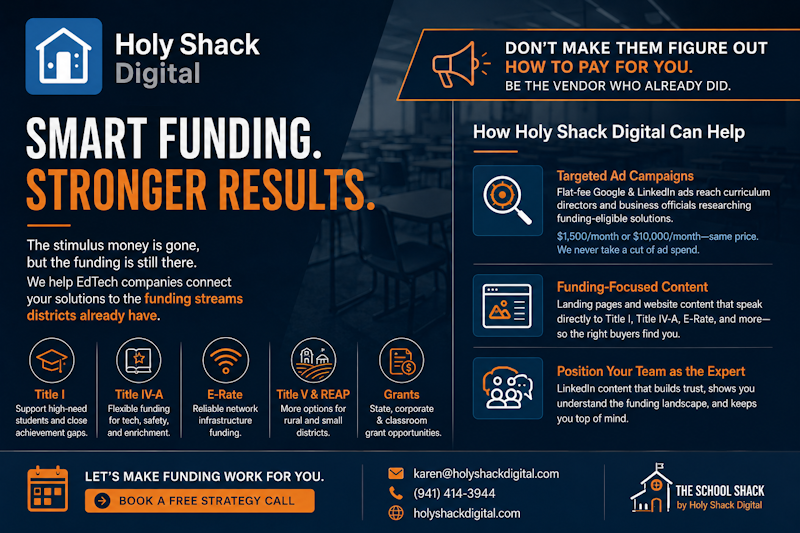
Flat-fee Google and LinkedIn ad management that puts your compliance messaging in front of IT directors and curriculum leads at the exact moment they're vetting vendors — without paying a percentage of spend as your campaigns scale.
📅 Book a free strategy call 📧 karen@holyshackdigital.com | (941) 414-3944 | holyshackdigital.com

Ready to Fill Your Calendar?
Book a free strategy call — we'll show you exactly how we'd run your ads and grow your business.